

The core of every surface technology project planning is a technical specification. Find out how to proceed the planning process step by step and avoid typical mistakes – to minimize undesirable developments, deadline delays, rework and cost overruns.
Why do projects fail?
10 mistakes you should avoid!
- Inadequate definition of requirements: Unclear or constantly changing requirements often lead to an end of line product which does not meet the expectations.
- Lack of communication: Poor communication between client and contractor leads to misunderstandings and misinterpretations.
- Inadequate resource planning: Insufficient personnel, budget or time can lead to the project not being completed as planned.
- Lack of expertise: Lack of necessary technical skills and experience often lead to errors, delays and ultimately to a project failure.
- Lack of stakeholder engagement: If relevant stakeholders are not actively involved in the project or show no interest in the project, important aspects are often overlooked.
- Poor project planning of surface engineering and management: It is not uncommon for a project to fail due to a lack of structured planning and effective project management practices, such as risk management, scheduling and regular progress reviews.
- Technological challenges: Unforeseen technical issues or an excessive complexity of the project may lead to technical solutions that cannot be implemented as planned.
- Resistance against changes: If the project introduces significant changes in work processes or technologies, resistance from users or stakeholders can cause problems.
- Lack of flexibility: Sticking too rigidly to the original plans without reacting to changing circumstances prevents successful project completion.
- Unrealistic expectations: If expectations regarding the time frame, costs or the technical feasibility are too high, the project is almost bound to fail.
How can these mistakes be avoided?
The solution: A technical specification?
A technical specification is a document that describes the technical requirements and expectations of a project in detail. It defines exactly what needs to be developed or delivered and forms the base for cooperation between the client and the contractor. Essentially, it is the wish list of requirements from the client’s point of view.
Advantages of project planning with specifications
For clients and responsible project managers, a technical specification sheet creates a binding base for surface technology project planning and prevents misunderstandings between all parties involved. In detail, a technical specification ensures:
• Clarity and structure right from the very beginning
The goal of the specification is to prepare the requirements for the contractor in such a way that they can understand the content fast and precisely. By clearly structuring the requirements, repetitions and contradictions requirements can be avoided: Clarity and structure ensure that partial content or even the entire specification is not reduced to absurdity.
Our suggestion: Use clear tables for special topics (such as container equipment) as an annex to the technical specification.
• Efficient communication
Whether project managers, users, maintenance staff or other stakeholders – everyone can refer to the specifications to understand what is required. Clear project planning for surface technology supports collaboration and reduces the risk of important information getting lost or misinterpreted.
Our suggestion: Regular jour fixes, online and face-to-face meetings promote an efficient exchange of information.
• Risk minimization and cost control
Recording all requirements inside the specification sheet enables a more precise assessment of the resources and the associated costs. Potential risks can be identified and scheduled at an early stage of the project. Precise project planning helps to avoid typical errors and unexpected expenses which prevent the project from going out of budget.
• Clear focus
The uncontrolled growth of the project scope is one of the most common reasons for project failure. Project planning specifications sets clear limits and serves as a reference when it comes to evaluating additional requirements or changes during the project. These limits ensure that the project does not get out of hand and that the original goals get not lost.
• Traceability and documentation
During the course of a project, many decisions are made that need to be traceable later on. The technical specification documents all requirements and thus forms the base for seamless project tracking. This documentation is not only valuable for the current project implementation, but also for later audits or as a reference for future projects.
Our recommendation: For these reasons, a description of the requirements in tabular form is particularly suitable. All points of the surface technology project planning can be clearly recorded and documented.
Here is an example of the requirements for containers.
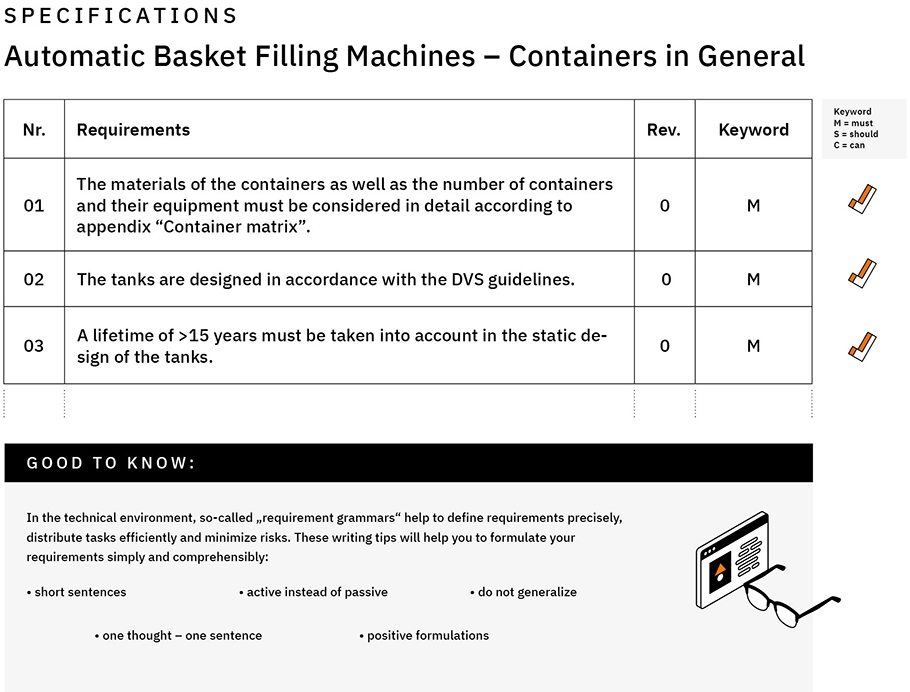
Our suggestion: The use of keywords allows the client to prioritize his requirements.
Download a free specification checklist here

Conclusion: Project planning for surface technology using specifications is always worthwhile
A well-prepared technical specification is far more than just a bureaucratic effort – it is an essential tool for the success of any project. It creates clarity, promotes communication, minimizes risks and ensures that everyone involved is working towards a common goal. In short: A technical specification sheet is the key to successfully project completion on time and on budget.

We would be happy to support you with our experience and expertise in creating your specifications. Our experts will explain to you what makes WMV’s specifications special and how they clearly stand out from the competitors.
Detlev Kroes, Sales & Projects